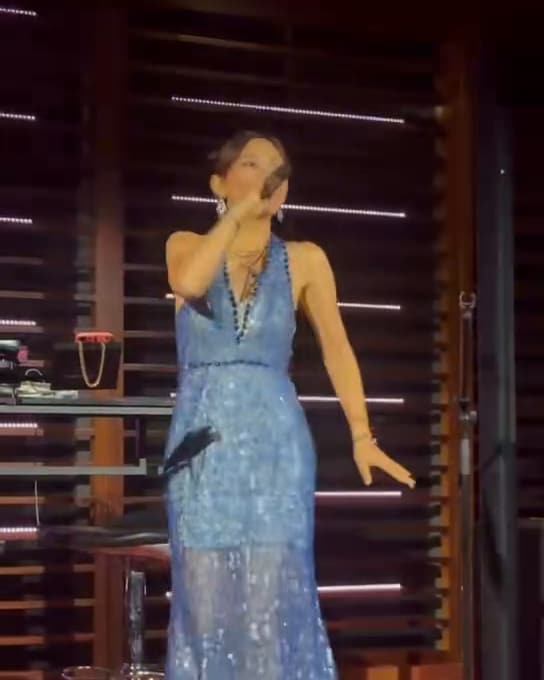
The Breath Sings
歌唱里的呼吸
The breath moves on its own. The voice rides out on it.
In Jaya's words
Most singing teachers will train you to control your breath. Take it in, hold it, push it out, support it. I teach the opposite. I teach the body to get out of the way.
When the body stops working so hard, the breath begins to move. It comes in because there is room for it. It goes out because it is ready to, and nothing has to be forced.
I tell my students that singing should feel wide open, like a room with the windows thrown back and the light coming in. That is not a reward at the end of years of training. It is what we look for in the first lesson.
Why singing feels hard
Most of us breathe shallowly, high in the chest, without ever noticing. Then we try to sing with that, and the only way to get the sound out is to push.
Pushing works, for a while. It also makes every phrase hard work and turns the high notes into a cliff edge. Lesson after lesson can pile technique on top of the effort, until the singer is skilled and strained at once.
Often the chest is lifted and braced, ready for the note before it comes. Held like that, the breath has little room to move. Jaya's instruction is short: drop your heart down. Let it settle. Then the air comes in.
What Jaya teaches instead
-
First, the feeling
Before the first note, the singer finds the wide-open feeling Jaya describes above. Every note after it is sung from inside it.
-
The body makes way
The breath needs no driving. Give it space and it takes it. The work is finding where you are still trying, and letting that go.
-
The breath returns
Left alone, it returns at the end of a phrase without a gasp. The singer learns to trust it rather than manage it.
-
Carried, not made
The voice sits on the moving air and travels with it. The out-breath is the phrase itself, so the sound never has to be propped up.
-
Resonance comes later
Only once the breath runs freely does Jaya turn to the resonant spaces of the chest and the head, and to the shaping of words. By then they come easily.
-
Why the lessons are quiet
Jaya's practice draws on the idea of qi, breath that flows wherever nothing blocks it. That is why the lessons are unhurried and attentive: drilling cannot teach you to notice.
How lessons unfold
Most people begin with The First Breath, five lessons on the breath itself, and most feel the change within them. From there the work usually continues in The Open Voice, where range, phrasing and your own songs grow from the new breath.
Trained and professional singers begin instead in The Unforced Voice, with the songs they already sing. Song and Stillness runs alongside, for anyone drawn to mantra and kirtan.
A note on wellbeing
Singing is also a form of slow, guided breathing. Research suggests that breathing at this pace goes with feelings of calm, and that amateur singers feel more at ease after a lesson than before it.¹² What Jaya's students report is simpler: a quieter body, and air they can feel moving.
Sources
- Zaccaro A. et al. (2018). How breath-control can change your life: a systematic review on psycho-physiological correlates of slow breathing. Frontiers in Human Neuroscience 12:353. doi.org/10.3389/fnhum.2018.00353
- Grape C. et al. (2003). Does singing promote well-being? An empirical study of professional and amateur singers during a singing lesson. Integrative Physiological and Behavioral Science 38(1): 65–74. doi.org/10.1007/BF02734261
What it feels like when it happens
Students describe warmth spreading through the body, and a moment of being completely present. Jaya's answer, when she hears it, is always the same: that's exactly it.

像阳光一样的感觉
When we sing, it truly feels like sunlight.
Start with a conversation
Sing a few notes if you like. Jaya will hear where the breath is caught, and that is where the work starts.
Book a free conversation